
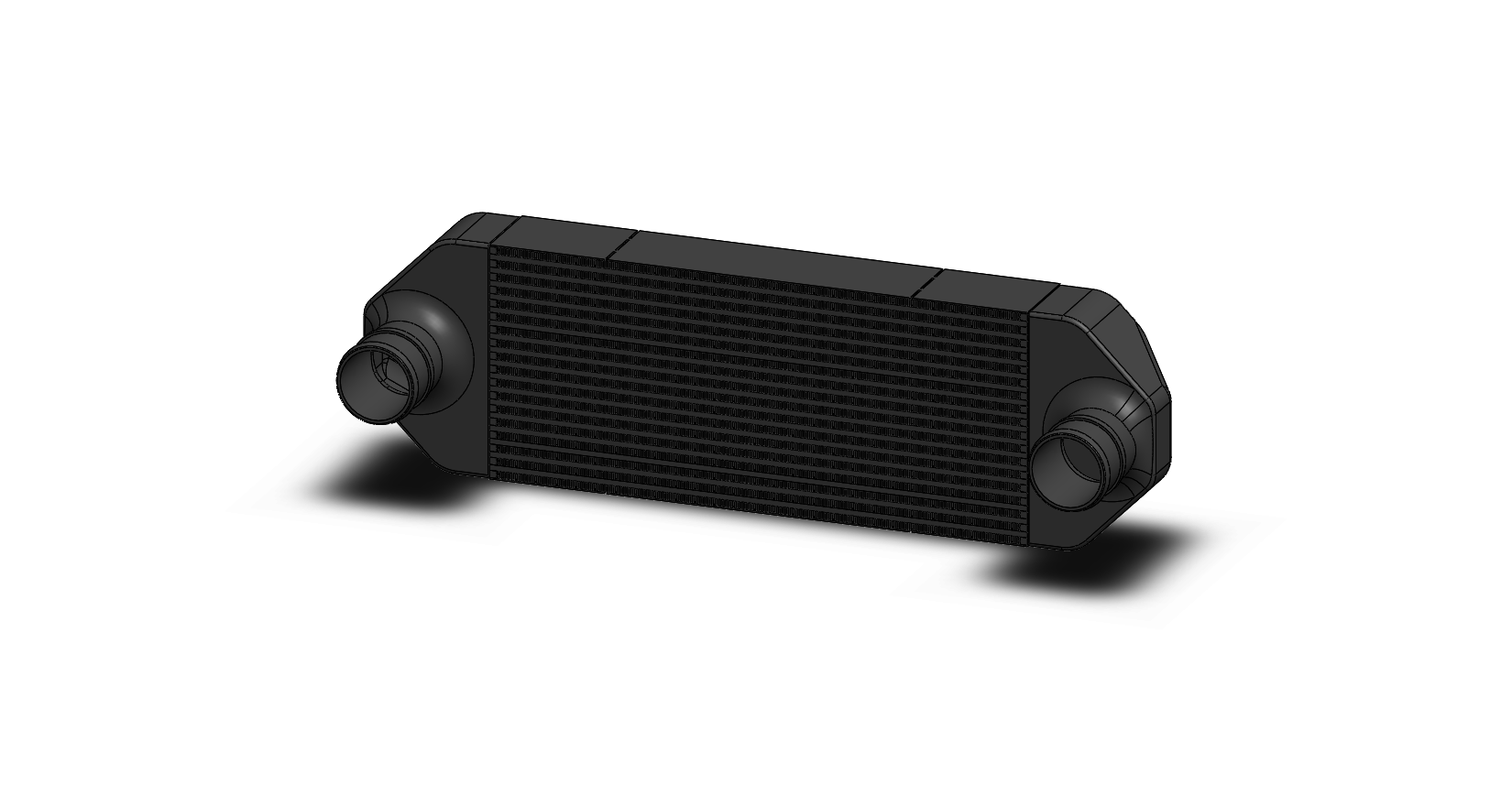
Bar & Plate CAC
- Application: Mobile Working Machines, Power Generation, On-Road & Off-Road Specialty
A Bar & Plate Charge Air Cooler (CAC) is a type of heat exchanger commonly used in automotive and industrial applications to cool the compressed air before it enters the engine’s intake manifold. It consists of alternating layers of flat bars (usually made of aluminum) and corrugated plates (also typically aluminum) assembled into a compact and efficient package.
- Design: Engineers design the CAC according to the specific requirements of the application, taking into account factors such as cooling capacity, space constraints, pressure drop, and durability.
- Material Selection: High-quality aluminum alloys are commonly used for the bars and plates due to their excellent heat transfer properties, lightweight nature, and corrosion resistance.
- Bar and Plate Fabrication: Flat bars and corrugated plates are manufactured separately through processes such as extrusion, casting, or machining. The bars are precisely machined to ensure uniform dimensions and optimal contact with the plates.
- Assembly: The bars and plates are assembled into a stack configuration, with the bars placed between the corrugated plates. This assembly forms alternating air passages through which the compressed air flows.
- Brazing: The assembled stack undergoes a brazing process, where the bars and plates are joined together using a brazing alloy. Brazing creates strong, leak-tight joints between the components while allowing for efficient heat transfer.
- Finishing: After brazing, the CAC undergoes finishing processes such as cleaning, deburring, and surface treatment to improve corrosion resistance and enhance appearance.
- Quality Control: Throughout the manufacturing process, quality control measures are implemented to ensure that each CAC meets specifications. This may involve inspection of individual components, pressure testing of the assembled units, and performance testing to verify cooling efficiency.
- Packaging and Distribution: Once quality control checks are completed, the CAC units are packaged for shipment to customers. Packaging materials are chosen to protect the units from damage during transit.
- Installation and Integration: Upon delivery, the CAC units are installed into the respective systems, such as automotive engines or industrial machinery. Proper installation and integration are crucial for ensuring optimal performance and efficiency.
Manufacturing Bar & Plate CACs requires precision engineering, careful assembly, and rigorous quality control to produce high-performance heat exchangers that meet the demands of various applications.